
Tree Care Resources & Expert Advice
Stump Grinding Cost in Calgary: What to Expect (2026)
So, your tree is gone. Whether it was removed by a pro, or maybe you and a few buddies took it down yourselves, either way, here you are, staring at a stump.
It’s easy to underestimate a stump. It just sits there, looking harmless, taking up space in your yard. But stumps can cause more headaches than most homeowners expect, and knowing your options before you act can save you time, money, and a few unexpected surprises.
At SAP Tree Removal, we’ve ground out stumps of every size, in every condition, across Calgary and the surrounding area. Here’s what we’ve learned.
DIY Stump Removal Options
Not everyone wants to pick up the phone, which is fair enough.
Depending on the size of what you're dealing with, you've got a few options.
Repurpose the Stump
Option one is to lean into it: break out the chainsaw and try your hand at stump carving, turn it into a flower pot stand, or build a little fairy home for the neighborhood kids.
Speed Up Natural Decomposition
Not feeling artistic? Option two is the slow burn: drill some half-inch to three-quarter-inch holes deep into the stump, fill them with Epsom salt, moisten it, and cover the whole thing with plastic or an upside-down flower pot.
Depending on the tree, this can take a year or two, sometimes longer, but it speeds up decomposition enough that you'll eventually be able to break the stump apart by hand.
Rent a Stump Grinder
If you don't want to wait two or three years to lay down sod, you've got other options.
You can always rent a stump grinder yourself for around $180, though you'll need a small trailer to get it there and back. Once you're set up, you're ready to roll.
Just be prepared for some kickback, because she can buck.
For very small stumps, a grinder will make short work of it. Bigger stumps, though? That can mean hours of physical, grinding work, and we mean that literally.
Stump Grinding Safety
Before you fire up any stump grinder, rental or otherwise, please take a safe approach.
Call Alberta One-Call First
If you have any uncertainty about what's underground, call Alberta One-Call for utility locates before you start. This is not optional.
Prepare the Work Area
Clear the surface area of any rocks or gravel before you begin. The grinding head moves fast, and it will send stones flying like mini projectiles.
You do not want to find that out the hard way.
Make sure nobody is standing directly in front of the machine while it's running.
Wear Proper Protective Equipment
Wear a face shield. Full stop.
And as for long, robust pants and steel-toed boots, if you need to be told to wear those for this kind of job, you probably shouldn't be doing this particular DIY in the first place.
Choosing the Right Stump Grinder
Not all stump grinders are created equal, and the machine matters.
Small Residential Stump Grinders
A good small grinder, with no self-propelled drive, can handle stumps up to about 8 inches before you start wishing you'd brought a bigger machine.
And on the smaller units, technique matters.
Just remember: it's all in the hips, it's all in the hips.
Professional Hydrostatic Tracked Stump Grinders
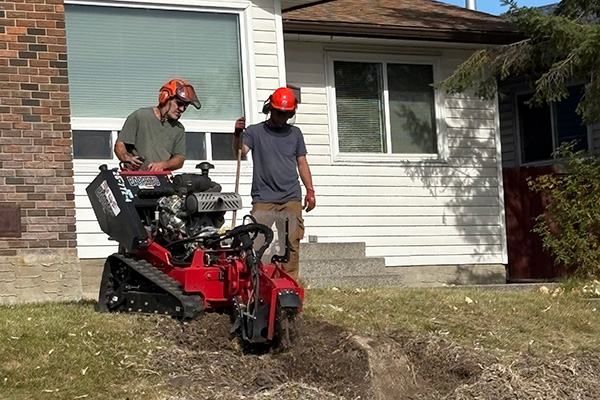
That brings me to the machine that is the urban arborist's choice: the Hydrostatic Tracked Self-Propelled Stump Grinder.
Picture a large tracked snow blower that had a baby with a table saw.
This thing will shred through stumps efficiently and effectively, though there is definitely a learning curve before you're getting the most out of it.
There are even larger machines out there, but those are typically reserved for forestry or land clearing operations, a different beast entirely.
The Life of a Stump: Biology, Benefits, and When It Becomes a Problem
Before we make the case for grinding, it's worth understanding what a stump actually does once it's left alone.
The Ecological Benefits of a Decaying Stump
A freshly cut stump is, in a sense, the beginning of a new ecosystem.
Fungi move in first, starting the slow work of decomposition. Insects follow: beetles, bark borers, and a variety of wood-dwelling species begin using the rotting wood as shelter and food.
Woodpeckers are attracted to stumps teeming with insects, drumming away in search of a meal.
In a naturalized or rural setting, a decomposing stump can quietly support a surprising amount of biodiversity over the years.
Why Stumps Become a Problem in Residential Yards
Because in a residential yard in Calgary, a decomposing stump tends to bring a different set of guests, and not all of them are welcome.
Ants and aphids are the most common issues we see, particularly with poplar and aspen stumps.
Rotting wood is prime real estate for carpenter ant colonies, and where ants go, aphids often follow.
Aspen Stumps, Weed Barrier, and Insect Activity
Here's something we've noticed on the job that doesn't get talked about much: there appears to be a real connection between columnar aspen stumps and elevated ant and aphid activity in yards where weed barrier fabric has been used in garden beds.
The fabric, especially when topped with wood mulch or decorative stone, seems to provide added habitat protection, creating warm, sheltered conditions that these insects thrive in.
If you've got weed barrier in your beds and an old aspen stump nearby, you may have unintentionally built a five-star resort for ants.
Other Reasons to Remove a Stump
Weevils and wood-boring insects can use rotting stumps as a staging ground.
Fungal growth can spread into lawn areas or garden beds.
Stumps create tripping hazards.
Poplar and aspen stumps often send up new shoots and suckers.
Nature's timeline for stump decomposition is measured in years, sometimes decades.
If you're not in a hurry, there are options.
But if you want your yard back, grinding is the most efficient path forward.
How the Stump Grinding Process Works
Stump grinding is exactly what it sounds like: a powerful rotating cutting wheel chips away at the stump and its root system, reducing everything to wood chips and grindings below the surface of the ground.
Understanding Root Systems
A smaller stump may only have roots extending a few inches below grade.
A larger stump can have roots extending much deeper, depending on the species.
Every stump tells its own story once we start grinding.
Choosing the Right Grinding Depth
The right depth depends on your plans for the space afterward.
Planting grass
Installing a deck or structure
Building a vegetable garden
We'd rather have that conversation before we start than have you end up with a result that doesn't match your plans.
What to Expect When Hiring a Professional
Getting a Quote
If SAP Tree Removal wasn't the company that removed the tree, we'll usually start by asking for photos.
A photo of the stump with a tape measure across it is incredibly helpful.
Site access photos and short videos are appreciated too.
The Day of the Job
Before we fire up the grinder, we'll assess the area, clear rocks and debris, and confirm utility locates where required.
After the Grind
Here's something most homeowners don't expect: the amount of material left behind.
A 36-inch stump can leave a crater 48 inches across or wider, plus a substantial pile of wood chips and loosened soil.
Replanting Grass After Stump Grinding
One thing worth knowing if you're planning to reseed or sod: fresh grindings can make it difficult for grass to establish.
Preparing the Area Properly
Our recommendation is to remove or compact the ground material down to about four inches below grade, then top up the rest with quality topsoil before you seed or lay sod.
It's an extra step, but it's the difference between grass that takes and grass that doesn't.
Stump Grinding Costs in Calgary
Let's talk money, because that's usually the next question.
How Most Companies Price Stump Grinding
Most companies charge based on stump diameter at ground level and maintain a minimum service charge.
SAP Tree Removal Pricing
At SAP Tree Removal, our minimum is $275, which generally covers the first stump up to six inches in diameter with straightforward access.
A thirty-inch stump can run upwards of $1,000 depending on site conditions.
Factors That Affect Cost
Stump diameter and depth
Site access
Equipment requirements
Number of stumps
Root complexity
Wood chip removal
Comparing Quotes
Get a few quotes.
Ask what's included.
Make sure you're comparing the same scope of work before making a decision.
Why Choose SAP Tree Removal
At SAP Tree Removal, we're a family-run operation serving Calgary and the surrounding area.
Greg has spent years in the field learning every variable that makes one stump simple and another one a genuine puzzle.
We'll tell you what the job actually involves, what it will cost, and why, before we start anything.
No surprises. No hidden scope. No walking away from the tricky ones.
Request a Free Stump Grinding Quote
Call us or use our online form to book a free site visit.
We want you to feel comfortable with the process from the very first conversation.



Info
206 3 Ave SW,
Diamond Valley,
Alberta, T0L 0H0
Service Areas
Calgary
Okotoks
Diamond Valley
Chestermere
Strathmore
Cochrane
Airdrie
