Tree Care Resources & Expert Advice
Why Are Your Poplar Trees Dying in Calgary? A Straight Answer from the Field (2026)
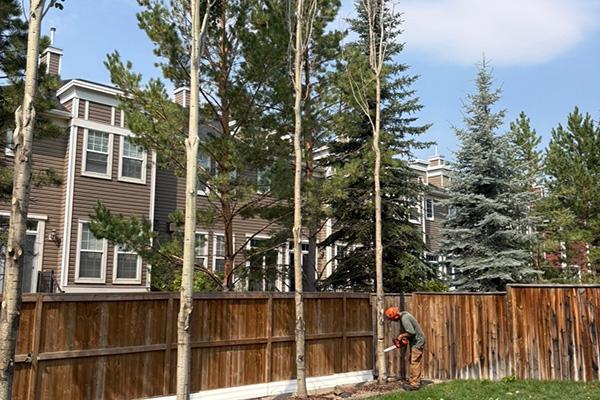
If you’ve got a row of columnar aspens in your yard and one of them is starting to look wrong, you’re not alone. Poplar and aspen decline is one of the most common calls we get in Calgary, and it’s also one of the most misunderstood.
People assume it’s disease. Or drought. Or just bad luck. And sometimes it is one of those things. But more often than not, when we walk a Calgary yard and look at a struggling poplar or columnar aspen, the answer is something the homeowner never considered, and something that’s entirely fixable if you catch it early enough.
Here’s what we actually see, and what you need to know.
The Calgary Poplar Situation: Why This Is Happening Now
Poplars are the backbone of Calgary’s urban forest. Roughly 70 years ago, there were only seven tree species that could survive in Calgary’s climate, and four of them were poplars. They’re the pioneers that built the city’s canopy, and they’re still the most common shade tree on Calgary streets and in Calgary yards today.
But there’s a problem. The hybrid poplars planted across Calgary’s communities in the 1960s, 70s and 80s have a natural lifespan of approximately 50 years. More than 20 Calgary communities now have aging monocultures of poplars that are at or past that threshold, and an estimated 10,000 public poplar trees are at or nearing the end of their life cycle. The City of Calgary has recently voted to accelerate their removal.
On top of age, Calgary has come through several serious drought years that have stressed the city’s trees on a widespread basis. Poplar trees, already at or near their lifespan limit in many neighbourhoods, have been hit particularly hard.
But here’s the thing: age and drought explain some of what we’re seeing. They don’t explain all of it, and in particular they don’t explain why so many younger columnar aspens in residential yards are failing years or decades before they should.
For that, you need to look at something most homeowners never think about.
The Weed Barrier Problem: The Biggest Killer Nobody’s Talking About
One of the first things I look for when I’m called out to a stressed or dying columnar aspen is what’s at its base. And more often than not, what I find is weed barrier.
I’m not prepared to say that weed barrier is the cause in every case. But in my observation and experience, it is present in the overwhelming majority of cases where columnar aspens are showing early decline, particularly dead or dying tips.
Here’s what’s actually happening.
Trees regulate their internal temperature through a process that runs from their uppermost tips all the way down to their root system. The roots are as much a part of that system as the canopy. When you lay weed barrier over the root zone of a tree, two things happen: it changes the temperature environment around the roots, and it traps moisture rather than allowing it to move naturally through the soil. That trapped moisture creates a kind of slow rot at the base, which triggers a stress response in the tree.
A stressed tree is an invitation. The stress response attracts non-beneficial insects, which move in and compound the problem. And once those insects have exhausted that tree as a host, they move on to the nearest like food source, which is usually the neighbouring columnar aspen in the same row.
This is how you lose a whole row, one tree at a time.
The Role of Gravel and Decorative Stone
The problem is made significantly worse when weed barrier is topped with coloured gravel, river rock, or decorative stone, which is exactly how most residential garden beds in Calgary are finished. The stone layer amplifies the temperature effect, creates an even more sealed environment, and gives insects ideal sheltered habitat right at the base of the tree.
Columnar aspens grown in natural grass or cover crop, rather than surrounded by weed barrier and gravel, are in a considerably healthier environment and show considerably fewer problems with insects and disease. The contrast between a well-planted columnar aspen and one planted into a gravel bed with weed barrier underneath is stark once you know what you’re looking at.
Greg’s Position on Weed Barrier
Weed barrier has its place. For thick compacted gravel pads and hard landscaping areas, it does what it’s designed to do. But in garden beds alongside trees and shrubs, it is not beneficial, full stop.
A thicker layer of natural mulch is at least as effective at suppressing weeds, and often more so, because most weeds in Calgary arrive by air as seeds rather than spreading from existing root systems in the soil. Good quality mulch breaks down naturally, feeds the soil, and allows the root system underneath to breathe. Weed barrier does none of those things.
If you’ve got columnar aspens in a bed with weed barrier underneath gravel or stone, the single most impactful thing you can do for those trees is remove the barrier and replace it with quality soil and mulch. Do it before the trees start showing symptoms, not after.
The First Signs of Decline: What to Look For
Poplar and aspen trees show their first signs of true decline in the crown, which is the uppermost tip of the tree. This is the furthest point from the root system, and therefore the first part of the tree to shut down when it’s in real distress.
The sequence of decline is rarely caused by one thing alone. It’s almost always a combination: an underlying stressor weakens the tree, which makes it susceptible to disease or insects, which compound the original problem. By the time the symptoms are visible, the chain of events has usually been in motion for some time.
Here’s what to look for:
Dead or dying tips. The first and most important sign. If the uppermost tips of your columnar aspen are brown and dead while the rest of the tree still has leaves, that’s the tree telling you something is wrong at the root level.
Out-of-season leaf change. Leaves changing colour or dropping earlier than the trees around them, or irregular colouration that doesn’t match the season.
Lack of budding in spring. Branches that don’t bud when they should are branches that are already gone.
Bore marks or sapsucker damage. Small holes in the bark, either in regular horizontal lines (sapsucker) or irregular entry points (wood-boring insects). An increase in woodpecker and sapsucker activity on your trees is a reliable indicator of insect infestation underneath the bark.
Brittle tips. Healthy young growth on a poplar should be soft and flexible. If the tips snap off cleanly and feel dry, the tree is drought stressed. As Greg puts it: if it crisps off like asparagus, it’s too dry.
The Diseases: Bronze Leaf Disease and Cytospora Canker
Bronze Leaf Disease
Bronze Leaf Disease (BLD) is a fungal infection that affects various poplar species and hybrids, including trembling aspen, Swedish columnar aspen, and tower poplar. It’s relatively new to Calgary and the broader Alberta region, and it can kill an infected tree within three to five years of initial infection.
In Calgary, BLD is most commonly seen on balsam poplar, though columnar aspens and other poplar varieties are susceptible. Symptoms typically appear in late summer or early fall: leaves turning orange-brown to reddish-brown, starting at the edges and moving inward, while the leaf veins often remain a bright green in contrast. Browning under the bark of affected branches is another sign.
The disease spreads through airborne spores, which is why it can move through a row of trees or spread to neighbouring properties. The spores overwinter in dead leaves and debris, and are released in spring when conditions are right.
There is no chemical treatment for BLD. Management relies entirely on pruning and sanitation.
Prune out infected branches 20 to 30 centimetres below the visible sign of infection, back into healthy wood.
Sanitize your tools between cuts using isopropyl alcohol or any alcohol of 60 to 90 percent concentration. If you need a field-friendly option, a 60 percent vodka purchased from any liquor store is technically sufficient. The important thing is the alcohol content, not the label.
Remove all infected material from the site. Do not compost it, chip it, or leave it on the ground. Bag infected branches and fallen leaves in regular garbage bags and put them in your regular garbage bin, not your green bin. The City of Calgary’s green waste goes to composting and is reintroduced to the city, which risks spreading BLD spores further. Until incineration facilities are available as an option, landfill is the correct disposal method.
Keep the ground around your trees clean of fallen leaves and debris, especially through fall and into winter.
If the infection has progressed to the point where multiple major branches are affected, or the disease appears to have entered the main trunk, the honest assessment is usually removal. At that stage, trying to prune your way out of it does more harm than good.
Cytospora Canker
Cytospora canker is a fungal pathogen that creates sunken, discoloured areas in the bark of poplar and aspen trees. Think of it as the tree’s failed attempt at healing a wound: what arborists call a localized, failed inclusion. Where a healthy tree would close over a wound cleanly, a tree compromised by Cytospora develops a canker instead.
The key distinction from Bronze Leaf Disease is where the symptoms appear. BLD shows up in the leaves first, spreading from the outside inward. Cytospora shows up in the bark, as sunken or discoloured patches on branches or the trunk.
Trees become susceptible to Cytospora canker through unmanaged breakages and improper pruning cuts. Stubs left behind after a cut, open wound areas, and storm damage all create entry points for the fungus. This is exactly why proper pruning technique matters, and why the collar cut discussed in the pruning article is not just about aesthetics.
Drought Stress: Calgary’s Compounding Problem
Calgary has been through several serious drought years recently, and poplars have shown the strain on a widespread basis. Because poplars are naturally riparian trees, meaning they evolved along rivers and streams where water is consistently available, they are less adapted to prolonged dry conditions than some other species.
Drought stress on a poplar doesn’t always look like what you’d expect. The most reliable indicator is the tips: healthy young growth should be soft and flexible. Drought-stressed tips become brittle and dry. If they snap off cleanly and feel like dried asparagus rather than a live branch, the tree is telling you it doesn’t have enough water at the root level.
The root system is everything. A tree with a compromised root zone, whether from compacted soil, weed barrier, construction damage, or roots that have been girdled by too-small a growing space, cannot access water efficiently even when water is available. Drought compounds every other stressor the tree is already dealing with.
If you want to water a stressed poplar effectively, get the water deep into the soil rather than running a hose at the surface. Deep watering encourages roots to grow downward, where moisture is slower to evaporate and more consistently available.
The Swedish Columnar Aspen: Beautiful on Paper, Demanding in Practice
The Swedish columnar aspen is everywhere in Calgary yards. It’s tall, narrow, fast-growing, and fills a vertical space in a landscape design in a way that few other trees can. On paper, it’s an easy choice.
In practice, it’s one of the most frequently stressed trees we see. And the reasons are almost always the same ones we’ve already covered: planted into a bed with weed barrier underneath gravel, spaced too close together, too close to structures, and then left without monitoring until something starts to look wrong.
Spacing: The Problem That Starts at Planting
Columnar aspens are often planted at the minimum recommended spacing, or even closer, because they look fine as young trees and the gap between them seems generous. It isn’t.
Greg’s rule of thumb: always plant at one and a half times the suggested spacing, not the minimum. If the instructions say six to nine feet between trees, plant at nine feet at minimum, and err toward twelve if you have the room. Trees that appear to have generous space between them as saplings can be growing into each other as adolescents, creating bark rubbing, branch competition, and the kind of inter-tree contact that damages both trees during wind events.
That physical damage is a distress signal, and a distress signal is a dinner bell for insects.
As for proximity to structures: a poplar planted too close to a house is a separate problem entirely, and one that tends to become apparent only when a large branch comes down in a chinook. Give any significant poplar a minimum of one and a half times the tree’s expected mature canopy radius as clearance from any structure.
When One Tree in the Row Goes
If you have a row of columnar aspens and one or two start showing bronze leaf symptoms or early crown dieback, it is worth trying to save the row. Remove the infected material, sanitize your tools, clean up the debris, and remove the weed barrier from the base of all the trees in the row, not just the ones showing symptoms.
The honest caveat: recovery is possible, but by the time most homeowners call, the tree that triggered the call is often already past saving. What we’re really doing at that point is protecting the rest of the row. Greg’s approach is to be direct about which trees need to come out and which ones can stay, even when that’s not what the homeowner wants to hear. Keeping a tree that’s already a STAG, Standing and Already Gone, doesn’t serve the trees beside it.
Old Age: When the Tree Has Simply Done Its Job
Not every declining poplar is diseased or stressed. Some of them are just old.
Calgary’s hybrid poplars planted in the 60s, 70s and 80s have hit or passed their natural 50-year lifespan. An old poplar at the end of its life looks different from a diseased one in its prime. The signs of age-related decline are brittleness and breakage: larger limbs failing in storms, branches that break without obvious disease in the wood, general structural weakness. What you won’t typically see is bad leaf health or the insect activity patterns that accompany a disease-driven decline.
A diseased tree that could have been saved earlier shows irregular or out-of-season leaf change, lack of budding in spring, bore marks or sapsucker activity, and the tip dieback that starts at the crown. Those are the signs that something intervened in the tree’s life before its time.
Knowing which one you’re dealing with matters, because the conversation that follows is different. An old tree that has lived its full life is a removal and replanting conversation. A tree that declined early because of weed barrier, compacted soil, or disease is a conversation about what changed and whether the conditions for the next tree will be any better.
What You Can Actually Do
If Your Tree Is Still Standing and Showing Early Symptoms
Remove all weed barrier from the base of the tree and replace it with quality topsoil and a layer of natural mulch. This is the single highest-impact intervention you can make for a stressed columnar aspen.
Remove gravel and decorative stone from the root zone. Anything that seals the soil and traps heat and moisture at the base of the tree is working against it.
If carpenter ants are present, treat the area with Borax before replanting. Ants are part of a healthy ecosystem at natural population levels, but a carpenter ant colony established in the root zone of a stressed tree is a compounding problem. Borax neutralizes the colony to a manageable level without eliminating it entirely.
Water deeply, not frequently. Get water down to the root zone rather than running a light surface spray. Deep watering grows deeper roots, and deeper roots are more drought-resistant.
Clean up fallen leaves and debris around any tree showing BLD symptoms, and bag the material for regular garbage, not green bin.
If the Crown Has Already Suffered Severe Dieback
If the uppermost portion of the tree has already shut down significantly, the honest answer is that you’re facing an uphill battle. The decision at that point is whether the financial investment of treatment and monitoring makes more sense than removal and starting again with a healthier tree in better conditions.
A tree going through a slow death is a STAG: Standing and Already Gone. It’s a term from the industry, and it describes exactly what it is. There’s no shame in making the removal decision early when the outcome is already written. What matters is what you plant next, and how you prepare the site to give that tree a better start.
A Note on City-Owned Poplars
If the poplar you’re worried about is on a boulevard or in a city right-of-way, the situation is different from a tree on your private property.
The City of Calgary recently voted to create an accelerated plan for removing aging and problem poplars, and is actively debating who bears the cost. Greg’s practical advice: start by determining who actually owns the tree. If the tree is located in a designated city tree zone, and other trees in that area are managed by the city, then in his view the city should take responsibility for that poplar as well.
If the tree is clearly within your personal property boundary, it is your responsibility.
To determine ownership, use the Urban Forest Management Map provided by the City of Calgary at calgary.ca. Search your address and look at the tree layer. If the tree is registered as a city asset, contact 311 to report your concern. Do not hire a private company to remove a city-owned tree without confirming ownership first, as unauthorized removal of a public tree can result in significant fines.
Why SAP Tree Removal
At SAP Tree Removal, we’re a family-run operation that focuses our work in Calgary and the surrounding area, and poplar and aspen work makes up a meaningful part of what we do. We’ve walked enough Calgary yards to know that what looks like a straightforward dying tree is often the result of something the homeowner can actually change, and we’d rather tell you what that is than just quote you a removal.
If your poplars or columnar aspens are looking wrong and you’re not sure why, give us a call or use our online contact form to get in touch. We’ll come out, take a look, and give you a straight answer.



Info
206 3 Ave SW,
Diamond Valley,
Alberta, T0L 0H0
Service Areas
Calgary
Okotoks
Diamond Valley
Chestermere
Strathmore
Cochrane
Airdrie
