Tree Care Resources & Expert Advice
Tree Pruning and Trimming Cost in Calgary: A Homeowner’s Guide (2026)
Most people use ‘pruning’ and ‘trimming’ interchangeably, and honestly, that’s fine. In practice, they refer to slightly different things, and understanding the difference can help you ask better questions and get a more accurate quote. But whether you call it pruning or trimming, the goal is the same: a healthier, safer, better-looking tree.
At SAP Tree Removal, pruning and trimming are some of the most satisfying work we do. Unlike removal, you get to keep the tree. Done right, a good prune extends the life of the tree, improves its structure, and can eliminate hazards before they become expensive problems.
Here’s what you need to know before you pick up the phone.
Pruning vs. Trimming: What’s the Difference?
Trimming is mostly about aesthetics and clearance. You’re cutting back growth to maintain shape, manage size, or keep branches away from structures, power lines, or your neighbour’s yard. It’s the equivalent of a haircut.
Pruning goes a step further. It’s a deliberate, targeted process of removing specific branches to improve the health and structure of the tree, and where you make the cut matters as much as which branch you’re cutting.
A proper pruning cut is made at the collar, which is the slightly inflamed-looking area where a branch meets a larger host limb. That collar is where the tree concentrates its healing response. The cut should be clean and smooth, and made at the right angle: following the angle of the branch down to the angle of the collar, not straight across. Done correctly, the tree responds by forming what arborists call an inclusion, essentially the tree’s own healing process closing over the wound cleanly.
The most common DIY mistake we see is leaving a stub. When you cut too far out from the collar and leave a section of dead branch behind, it creates a wicking effect where moisture travels down into the tree. Over time, that leads to rot working its way into healthy wood. It’s one of those things that looks fine at first and causes real problems two or three years later.
In practice, most jobs involve both trimming and pruning. We’ll clear what needs clearing and prune what needs pruning, and we’ll tell you which is which and why.
Why Prune or Trim a Tree?
There are a few good reasons to pick up the phone, and they’re not all about looks.
Safety. Dead, dying, or overextended branches don’t announce when they’re going to come down. If a branch falls on a fence, a car, or a person, that’s a very different kind of expensive than a pruning quote.
Tree health. Crossing branches rub against each other and create wounds. Crowded canopies restrict airflow and light, creating conditions that fungal disease loves. Removing the right branches lets the rest of the tree thrive.
Structure and balance. One of the main things we look for when pruning is overall balance. A lopsided or top-heavy canopy puts uneven stress on the trunk and root system. Getting the structure right, especially on younger trees, means less intervention and a stronger tree over the long term.
Clearance. Branches growing into power lines, over rooftops, or up against structures need to come back. The longer you wait, the more complex and expensive that work becomes.
Aesthetics. Sometimes you just want the tree to look right. That’s a perfectly valid reason, and a good trim can transform how a yard feels.
A Word on Tree Topping: Please Don’t
Tree topping is the practice of cutting a tree’s main branches back to stubs, usually to reduce height quickly. It’s unfortunately common. And it’s one of the most harmful things you can do to a tree.
Here’s what actually happens after a tree is topped: the tree goes into survival mode. Without a termination point for the growth signal, the tree sends up fast-growing, weakly attached shoots from every cut point, trying to recover its lost canopy as quickly as possible. These water sprouts are structurally poor, prone to breakage, and the tree often ends up taller and more hazardous within a few years than it was before topping.
The cuts themselves are also large wounds, and large wounds on topped branches expose the core wood directly to the elements. That core wood can start to decay rapidly, which over time can make a topped tree genuinely hazardous, not just unsightly.
We prefer not to top trees. If a customer asks for it, we’ll do the job if it’s truly necessary, but we’ll always walk through the likely consequences first. If your concern is height or canopy size, we’ll talk through the right approach, whether that’s a crown reduction, selective pruning, or in some cases, an honest conversation about whether removal might be the better long-term answer.
The Calgary Elm Rule: October 1 to March 31
If you have an elm tree in Calgary, there is one rule you need to know: elm trees in Alberta may only be pruned between October 1 and March 31.
This isn’t a SAP policy. It’s provincial regulation, enforced to protect Alberta’s elm population from Dutch Elm Disease. DED is a devastating fungal disease spread by elm bark beetles, which are active during the warmer months. Fresh pruning wounds during beetle season are an open invitation. Alberta is one of the last places in North America with a healthy elm population, and the pruning window exists to keep it that way.
One more thing on elm: all pruned elm wood must be burned, buried, or chipped by March 31. You cannot store it. Stored elm wood harbours beetles even in winter. This is a provincial requirement, not a suggestion.
If you ask a tree company to prune your elm outside of that window and they agree without flagging this, that’s worth paying attention to. A company that doesn’t know the elm rules probably has other gaps too.
Book your elm pruning in the fall or winter. We’ll remind you if you forget.
What Affects the Cost of Tree Pruning and Trimming in Calgary?
Pruning and trimming pricing is more variable than removal pricing, because the scope can range from removing a few dead branches to a full crown reduction on a mature tree. A tree that has been regularly maintained won’t cost nearly as much to prune as one that hasn’t been touched in a decade. Here’s what moves the number.
Tree Size and Species
A small ornamental tree and a mature Manitoba maple are very different jobs. Size determines how long we’re in the tree, and species affects how the wood behaves and how carefully each cut needs to be made. Fruit trees, ornamentals, and specimen trees often require a more deliberate approach than a fast-growing poplar.
Canopy Density and Amount of Material
Two trees of the same height can be completely different jobs depending on how much material needs to come out. A dense, overgrown canopy that hasn’t been touched in years is a much bigger undertaking than a maintenance trim on a well-managed tree. If you’re starting from scratch on a neglected tree, expect the first visit to cost more, with subsequent ones significantly less.
Access and Location
Same rule as removal and stump grinding: how do we get to the tree, and what’s underneath it? A tree in an open backyard is straightforward. A tree overhanging a structure, a pool, or a neighbour’s property requires more care, more rigging, and more time.
Climbing vs. Equipment
Some trees are climbed. Some are worked from a boom lift or aerial platform. The right approach depends on the tree, the access, and what the job requires. Equipment can be faster on the right job, but it isn’t always the right tool, and not every yard accommodates it.
Dead Wood
If your tree has significant dead wood in the canopy, that’s typically addressed as part of a pruning visit. Dead wood removal adds time, but it’s important for safety and tree health. If you’re not sure whether your tree has dead wood, that’s exactly what a site visit is for.
Tree Pruning and Trimming Price Ranges in Calgary (2026)
The following ranges are based on industry experience and real-world quoting in the Calgary market. All prices are in CAD and cover pruning and trimming only. As with all our services, every job is quoted individually as no two trees, and no two yards, are exactly the same.
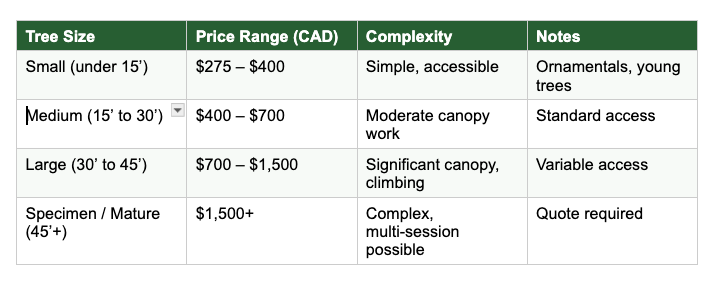
A few things worth keeping in mind: these ranges assume a single tree with reasonable access. Multiple trees on the same property are typically quoted together, and the per-tree rate often improves when we’re already mobilized and on site. Heavily neglected trees, or trees requiring significant rigging due to structures underneath, will sit toward the upper end of their size range or beyond it.
Trees that are pruned regularly also cost less to maintain over time. A well-managed tree is a faster, cleaner job than one that’s been left for years. It’s one of the better arguments for staying on top of it.
Our minimum call-out for pruning is $275, the same as our other services. As always, the best way to get an accurate number is to have us come out and take a look.
Pruning vs. Removal: How to Know Which One You Actually Need
Pruning and removal aren’t interchangeable, but there are situations where a tree that looks like a pruning job turns out to be a removal conversation, and vice versa.
A tree that is structurally sound, well-located, and fundamentally healthy is a pruning candidate, even if it’s large, overgrown, or has some dead wood. With the right work, that tree can be safe and healthy for decades to come.
A tree with significant structural failure, advanced disease through the trunk, extensive root damage, or that is simply in the wrong location for the long term is often better removed than repeatedly maintained. Keeping a declining tree going can become more expensive over time than addressing it once and starting fresh.
We’ll always give you our honest read on which one makes sense, and we’ll explain why. If pruning is the right answer, we’ll say so. If removal is the smarter long-term move, we’ll say that too.
Why SAP Tree Removal
At SAP Tree Removal, we’re a family-run operation that focuses our work in Calgary and the surrounding area, and that means something to us. Pruning is skilled work, and a bad pruning cut can cost a tree its health or its life. We take that seriously. Whether it’s a single ornamental that needs tidying or a mature canopy that hasn’t been touched in years, we’ll come out, take a look, and give you a straight answer on what the tree needs and what it will cost.
Call us or use our online form to book a free site visit. We want you to feel comfortable with the process from the very first conversation.



Info
206 3 Ave SW,
Diamond Valley,
Alberta, T0L 0H0
Service Areas
Calgary
Okotoks
Diamond Valley
Chestermere
Strathmore
Cochrane
Airdrie
